← Back to projects Mechanical Load Severity Comparison
MSc thesis with Thales Alenia Space: from SDOF spectra to a 6-DOF interface-force criterion
Qualification tests are only meaningful if they are at least as severe as the real environment. This thesis, carried out with Thales Alenia Space, reviews the classical severity metrics (Shock Response Spectrum, Extreme Response Spectrum, Fatigue Damage Spectrum), shows where their single-degree-of-freedom assumption breaks down, and proposes a force-based criterion for comparing multi-axis (6-DOF) loads, validated against MSC Nastran. The work led to a paper at ECSSMET 2024.
~38x
Faster SRS (Smallwood vs. lsim)
~6x
Faster ERS (Lyapunov, given filter)
up to ~75%
ESI vs. CLA gap on a heavy sub-system
Shock Response Spectrum
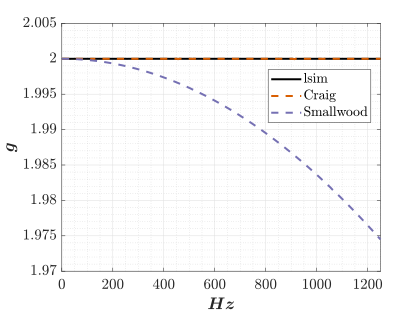
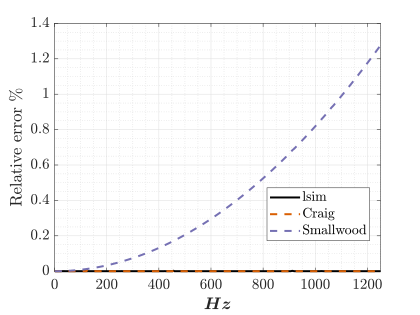
Three SRS algorithms (direct lsim integration, Craig recurrence, Smallwood recursive filter) were benchmarked on a step input with a known analytical answer. Craig and lsim are exact, while Smallwood drifts at high frequency (≈1.3% error at 1250 Hz with a 1e-4 s step) because it assumes zero initial conditions, but it is about 38 times faster than lsim. Refining the time step removes the error at a higher computational cost.
Extreme Response Spectrum
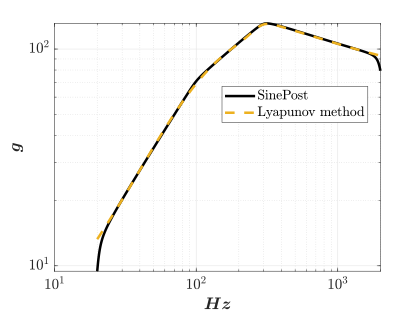
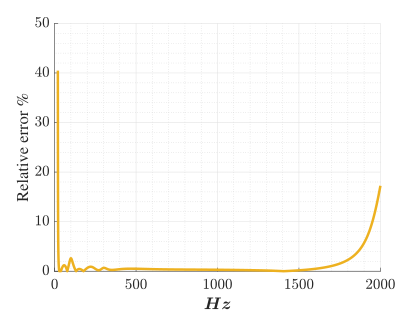
For random vibration, the classical ERS (integral of the transmissibility) was validated against SinePost and compared with a state-space Lyapunov approach: a shape filter fitted to the APSD specification is put in series with the SDOF system and the response variance comes from the Lyapunov equation. When the filter is already known (e.g. from a standard or a launcher user manual), the loop over frequencies is about 6 times faster, with deviations only where the filter cannot follow the specification (its sharp corners and the band edges).
Fatigue Damage Spectrum
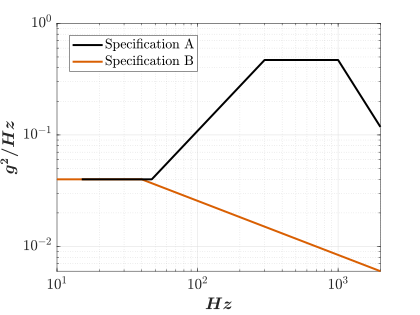
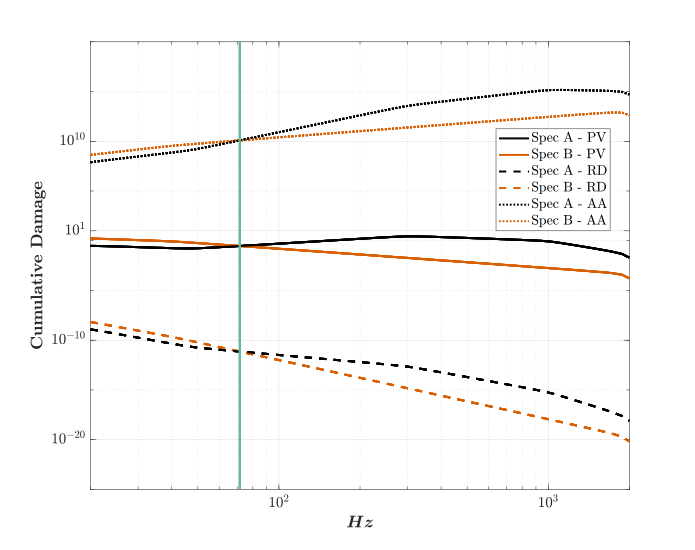
Two random specifications were compared through their FDS assuming stress proportional to pseudo-velocity, relative displacement or absolute acceleration. All three choices give the same conclusion and crossing frequency (≈71.6 Hz): the comparison is independent of the stress quantity, and APSD levels alone (a density) are not a valid severity measure.
Where SDOF Metrics Break Down
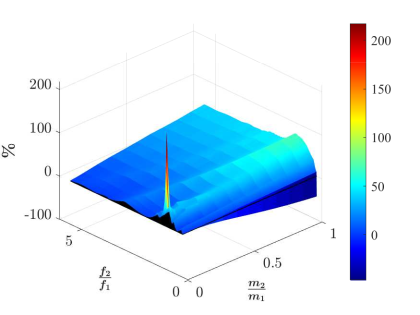
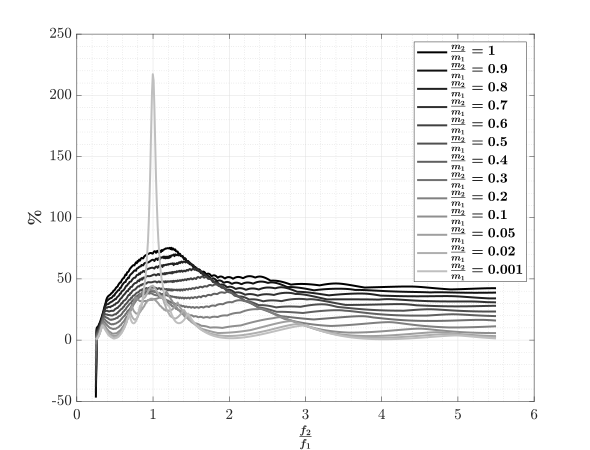
A 2DOF spacecraft + telescope model, matched to a Femap model (55.6 Hz and 93.2 Hz), was excited both with the transient coupled-loads acceleration and with its Equivalent Sine Input. The ESI overestimates the responses (+6.6% on the spacecraft, +7.8% on the telescope), and a parametric sweep of mass and frequency ratios shows the gap on the sub-system growing to about 75% when it is heavy and its frequency is close to the main one. In those cases secondary notching based on the ESI is overly conservative, which costs mass.
A 6-DOF Force-Based Criterion
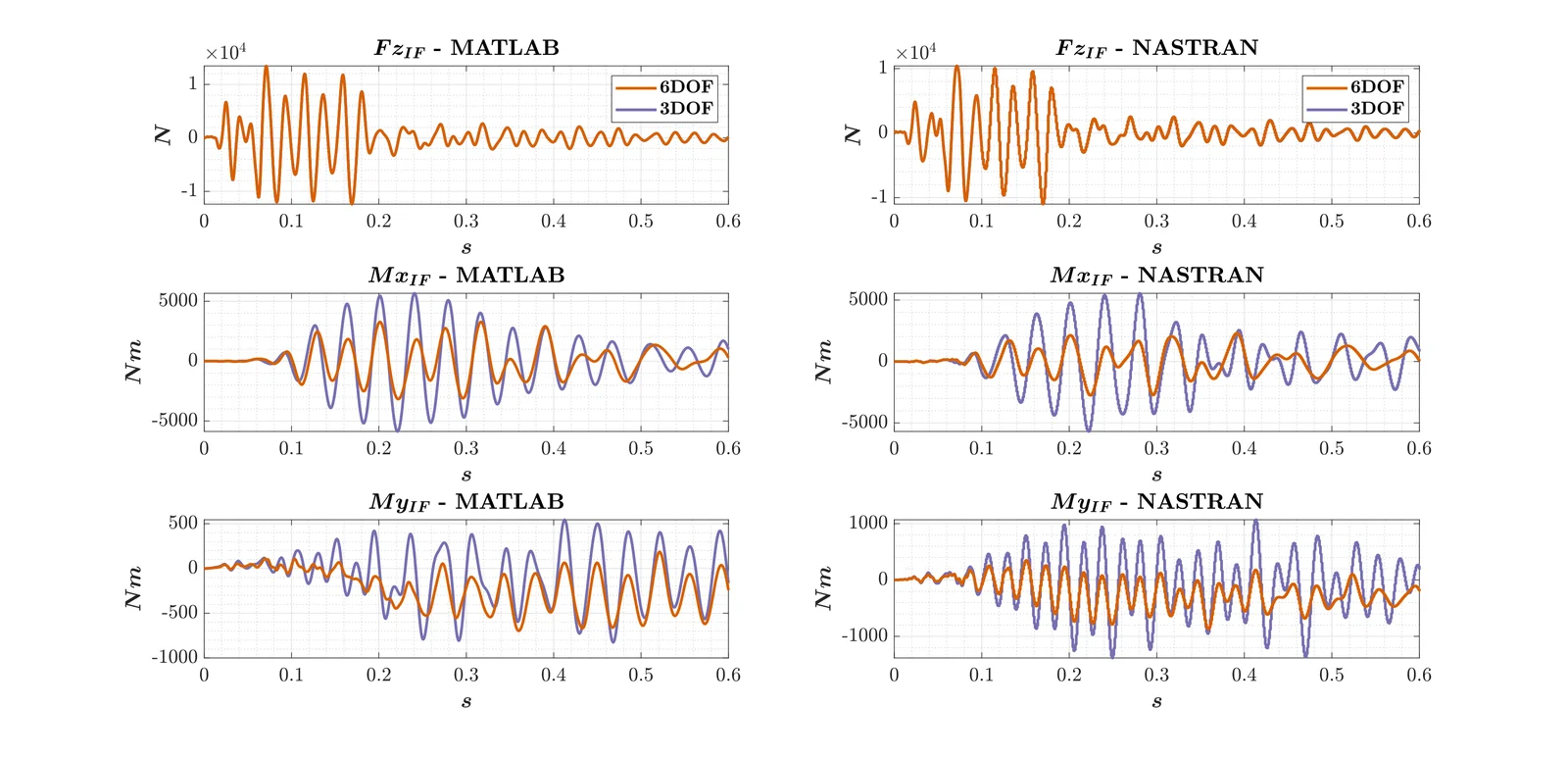
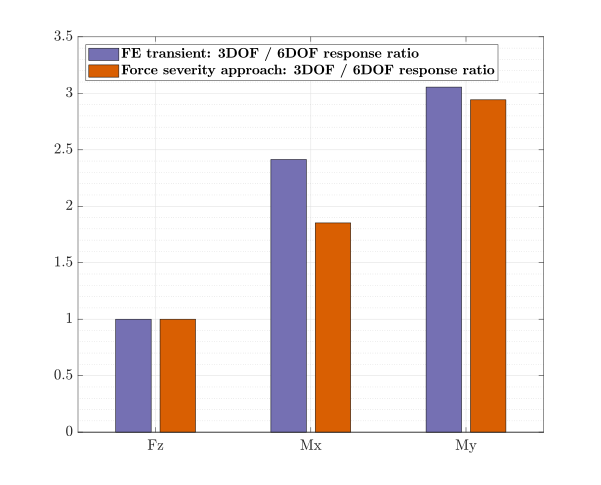
Since moments depend on inertia, the severity of a multi-axis base excitation is defined on the interface forces and moments. The proposed method needs only the rigid-body mass matrix and the first natural frequency per axis, with no full transient FE run. Applied to a spacecraft on a launcher adapter with a CLA-derived acceleration, it approximates the severity ratios of a full MSC Nastran transient and shows that axis-by-axis (3-DOF) testing overestimates the real 6-DOF interface moments by up to ~3x, i.e. overtesting. This is relevant now that 6-DOF shakers enter qualification testing.
What I Learned
Working with Pietro Nali (Thales Alenia Space) and Prof. Lorenzo Dozio, I learned how environmental test specifications are actually derived and justified in industry, and how easily a widely used metric can hide its assumptions. Implementing every method from scratch in MATLAB and checking it against an analytical case or a commercial tool (SinePost, MSC Nastran) became a habit I still follow. It was also my first experience turning a thesis into a conference paper.